
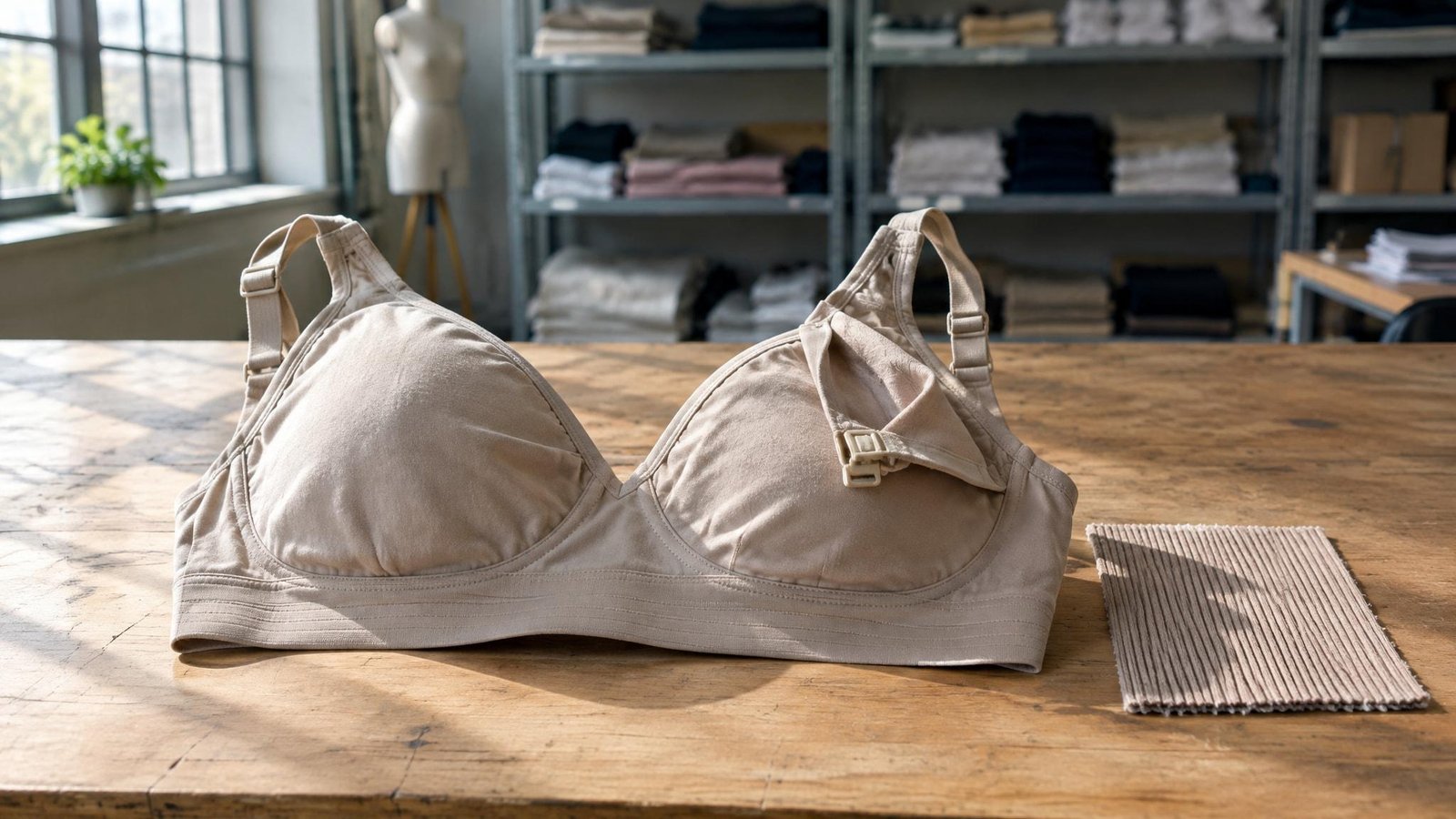
Nursing Bra Manufacturer: What to Check Before You Sign
Search for a nursing bra manufacturer and you mostly find directories: a company name, a country, a contact button. What you don’t find is a way to tell one factory from the next.
We wrote this checklist from the factory side of the table. Use it on any supplier on your shortlist, including us. It covers what decides whether a nursing bra sells and stays sold: how the cup opens, how the knit feels, how the band recovers, and how a sample becomes a bulk order.
What a Nursing Bra Manufacturer Should Offer Beyond a Factory Listing
The demand behind this category is steady rather than seasonal. Over 83 percent of babies born in 2019 started life receiving some breastmilk, per the CDC as reported by Consumer Reports, but only just over half were still nursing six months later. That is a long stretch of daily wear, and every weak clip or scratchy seam shows up in it.
A listing tells you a factory exists. A good nursing bra manufacturer shows you finished products you can handle, explains how they are built in plain terms, and is open about how it samples and checks quality before bulk. Public health guidance, such as this nursing bra page from Grey Bruce Public Health, keeps returning to three things: comfort, fit and easy access for feeding. We use the same three as the test for every sample.
A nursing bra that fails at feeding time rarely gets a second chance with the customer.
The sections below cover closures, seamless wireless construction, sampling and QC, customization routes, and MOQ and pricing. The last one gives you questions to put to any supplier before you sign. If you sell online, your reviews will tell you within weeks whether you skipped a check.
Clip-Down and Front-Open Designs: Check the Mechanism First
Closures are where nursing bras differ most from ordinary bras, and where cheap production shows first. Before you compare fabric or price, confirm that the opening mechanism does its job.
How clip-down cups should work for one-handed feeding
A mother is usually holding a baby with one arm. The clip has to release with the other hand, without looking, without force and without a loud snap. It also has to close again without careful alignment, because nobody lines up a tiny hook at 3 a.m.
In a sample, look at four things:
- Release effort: the clip should open under light thumb pressure but not pop open when the wearer lifts her arms.
- Cup drop: the cup should fold down fully and stay clear of the breast, rather than flipping back up.
- Edges: the clip, its housing and the strap anchor should never press into skin.
- Fabric snagging: the closure should not catch the knit when opening and closing.
Our clip-down seamless nursing bra for wholesale is a good reference point for this kind of design. Open and close it with one hand many times in a row, then keep going until you see wear. A clip that feels fine on the first try can loosen by the fiftieth.
Front-open styles and what to test in the closure
Front-open bras use hooks or a front fastening instead of a drop cup, which some wearers find easier to adjust. The risk is bulk. A hard closure that sits under the breast or along the center can dig in when the wearer lies down to feed or sleep.
Test the closure lying down as well as standing. Check that the hooks line up neatly, that the fabric around them stays flat under a T-shirt, and that nothing rubs after a few hours of wear. Our front-opening wireless maternity bra shows this approach in a seamless, wire-free build. For buyers who want both features in a plus-size style, our range also includes a wholesale clip-down nursing bra with a front-opening seamless wireless design.
Seamless Wireless Construction: Support Without Underwires
Postpartum bodies are tender and change from week to week, so a seamless, wire-free build suits this category well, though it only works when the knit and the band are engineered properly. Ask your nursing bra supplier to explain both in detail, because a factory that can’t explain them is probably not controlling them.
Seamless knitting and fabric feel for postpartum comfort
Seamless knitting shapes the garment on the knitting machine instead of cutting flat panels and sewing them together. The result has far fewer seams, and fewer seams means fewer places to rub against sensitive skin, especially around the cups and sides.
Put these questions to any factory:
- How is the knit structured to give extra stretch or support in different zones of the cup and band?
- What yarn blend is used, and how does the fabric feel after several washes?
- Does the lining lie smooth when the cup is dropped, or does it bunch?
Our seamless soft wireless nursing bra is built around this idea: a soft, close-fitting knit with no wire to press on tender tissue. Hold it against the inside of your wrist for a minute. If you notice an edge or a ridge, a nursing mother will notice it more.
Wireless support: stretch, recovery and sizing range
Wireless does not mean unsupported, but it does mean the knit does the work the wire used to do. What you want is stretch that lets the cup follow the breast through the day, and recovery that brings the band back to its original shape after wearing and washing.
A bra that stretches out within a month is the most common complaint in this category, and it is a recovery problem rather than a fit problem. Stretch the band wide, release it, and see whether it returns to size. Then wash the sample several times and repeat the test.
Size spread matters just as much. Breast size changes during feeding and across the months, so a narrow size run means more customers fall outside it. Ask for the full size range in writing, and confirm that plus-size options use the same construction rather than a stretched-up version of a smaller pattern.
Wireless is also not for everyone. If your customers expect a rigid, lifted shape from an underwire, a seamless nursing bra will disappoint them. It is designed for comfort, easy access and everyday support.
The Sampling Process and QC: How to Verify Quality Before Bulk
A sample is the only honest preview of bulk production. If you treat it as a courtesy and not as a test, you are paying for the lesson later, in returns.
What to request in a sample and what to test
Ask for samples in more than one size, including the smallest and largest you plan to sell, because problems often appear at the extremes. Then run a routine that stresses what a real wearer will:
- Wash: launder the sample several times following its care label, then compare color, fabric feel and band shape with an unwashed one.
- Stretch: pull the band and cups to their limits and check recovery, as described above.
- Clip cycles: open and close the mechanism repeatedly with one hand.
- Fit on real people: have several people try each size and report on comfort, access and movement.
- Spec check: measure the sample against your tech sheet, since a pretty sample that misses your measurements is still a miss.
Keep notes on each round. When you send feedback, a factory with a proper sampling process will revise and resend, not defend the first version. After you approve a sample, it is worth comparing the production-run pieces against it before you accept delivery.
QC checkpoints from fabric sourcing to packaging
Quality is rarely lost at one point. It leaks away across fabric, knitting, sewing, finishing and packing, which is why a factory that controls every step is easier to hold to a standard than one that passes work between outside vendors.
We control every step from fabric sourcing to final packaging. That means a defect found at the end can be traced back to its cause, whether that was a yarn lot, a machine setting or a trim, instead of being argued over between suppliers. Whichever factory you choose, ask which of these stages it handles itself:
- Incoming fabric and trim inspection
- Checks during knitting and sewing
- Final inspection of finished pieces, including closures
- Packing checks for labels, sizes and counts
Ask to see how defects are recorded and what happens to a batch that fails. You will learn more from that answer than from any certificate on the wall.
OEM, ODM and Private Label Options for Nursing Bras
These terms get mixed up in sourcing conversations, and the confusion costs time. Nursing bra OEM means the factory builds a product to your design and specifications. ODM means the factory brings an existing, proven design that you adapt and sell as yours. Private label is the branding layer: your name on the label, tags and packaging, whichever route produced the bra.
What you can customize: fabric, colors, trims, labels, packaging
A custom nursing bra manufacturer should let you shape more than the logo. The usual options are:
- Fabric: the knit and feel, within what the factory can source.
- Colors: your palette in place of the standard line.
- Trims: clips, hooks, straps and elastics.
- Labels: woven or printed brand labels and size tags.
- Packaging: boxes, hang tags and polybags that match your brand.
Because we handle everything from fabric sourcing to final packaging, these choices sit in one conversation instead of several. Be clear about what you want early. Changes to the mechanism or the knit structure take more development than a new color.
Choosing between OEM and ODM for a new line
If you are a boutique owner or online seller launching your first nursing line, ODM is usually the faster way in. You start from a tested design, add your private label, and adjust details. An established brand with its own patterns and fit blocks will usually prefer OEM, since the factory then reproduces your exact specification.
You can see what is possible in our OEM/ODM nursing bra for B2B supply, a front-open, wireless seamless style that works as a starting point for either route. Send us your target customer and we can suggest which one fits.
MOQ, Pricing and Lead Times for Wholesale Wireless Nursing Bras
Three numbers define a supplier offer: minimum order quantity, price tiers and turnaround. Compare them on the same basis across your shortlist, because a low unit price with a high MOQ or a long wait can cost you more than a slightly higher price with flexible terms.
When you ask for quotes, find out whether the MOQ applies per style, per color or per size. Ask where the price tiers break and what each tier saves you. Confirm whether labels, packaging and sample costs are included. Find out whether the lead time starts at order or at sample approval. For reference, the nursing bra styles in our range are listed at around USD 19.98, an indicative figure that may change, so check the product page for the current price. Our bulk order nursing bra is one example of the seamless clip-down wireless style you can quote against.
Timing also affects how you plan stock. Consumer Reports’ guidance is to shop for nursing bras in the last one to two months of pregnancy, and one expert it cites recommends waiting until 36 weeks. Retailers should therefore have nursing styles in stock and promoted before that window opens. A factory with fast turnaround lets you place that order closer to the season instead of guessing months ahead.
Flexible MOQs for testing a new line
A first order is a test, not a commitment to a full season. We offer flexible MOQs and wholesale pricing for businesses of any size, so a small boutique can try one style in a few colors before committing further.
Tell us your budget and how many styles you want to test, and we will build the order around that. Start with the style your customers are most likely to ask for, watch how it sells, then reorder or expand.
Partnering with a Factory: Questions to Ask Before You Sign
A good factory relationship shows up in small things well before the first bulk order. Before you sign with any nursing bra supplier, get clear answers on:
- Communication: a named contact, a typical reply time and who handles problems.
- Consistency: how the factory keeps the tenth batch matching the approved sample.
- Delivery reliability: how it flags a delay, and what it does about it.
- Reorders: how easily you can repeat a style and scale quantities as you grow.
- Development: how many sample rounds are normal and what each costs.
Vague answers are a signal. Specific ones, backed by samples you can handle, are what a dependable partner sounds like.
If you are ready to test a line, we would be glad to hear from you. Request nursing bra samples and a custom quote from Sofinairea, tell us your market and order size, and we will work out a plan that fits your business.
Frequently asked questions
What is the difference between a nursing bra OEM and ODM?
With OEM, the factory produces a bra to your own design and specifications. With ODM, the factory supplies an existing design that you adapt and sell under your brand. Private label is the branding on top of either, covering your labels, tags and packaging.
Can I order a small quantity of wireless nursing bras to test the market?
Yes. Sofinairea offers flexible MOQs for businesses of any size, so you can start with one style in a few colors. Tell us your budget and target customer when you request a quote, and we will shape the first order around it.
What should I test in a nursing bra sample before placing a bulk order?
Wash it several times, stretch the band and check that it recovers, and open and close the clip or front closure repeatedly. Fit it on real people in several sizes, including your smallest and largest. Finally, measure it against your tech sheet.
When should I stock nursing bras for expectant mothers?
Experts quoted by Consumer Reports advise shopping in the last one to two months of pregnancy, and one suggests waiting until 36 weeks. Have your nursing styles in stock and promoted before that window. Work backwards from there to set your order date.
Are wireless nursing bras suitable for every customer?
Not for everyone. Seamless wireless styles are built for comfort, easy access and everyday support. Customers who want the rigid lift of an underwire may prefer another type of bra.